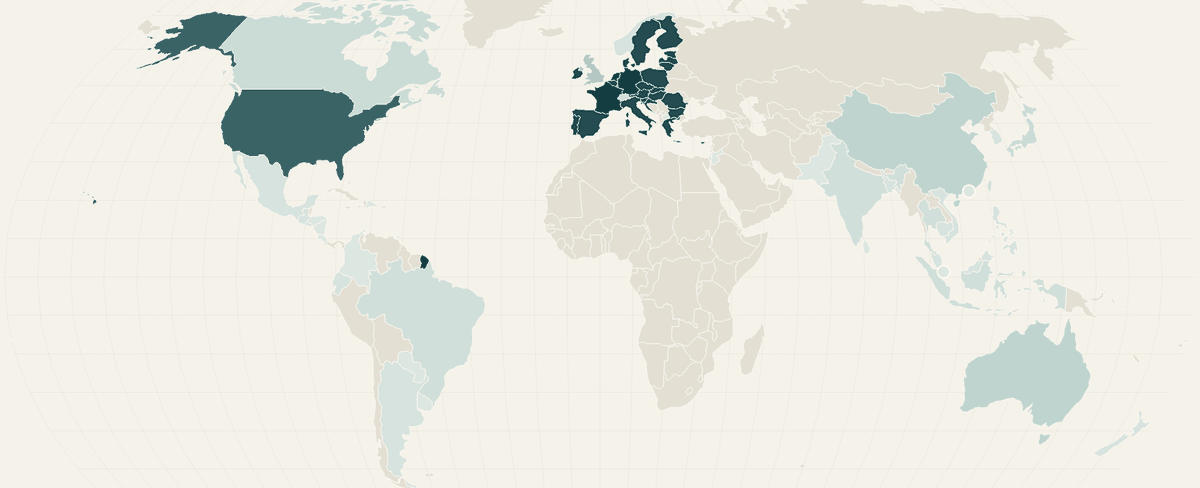
I’ve been arguing that sustainability is moving from being driven by reputation to being driven by regulation. But, which regulations, and where? How do these impact businesses of different types in different locations with different products? Also, how does interoperability work across all this complexity and how might companies build robust systems that meet the requirements of the (various) laws and have the impact desired (e.g., no forced labour)?
To answer these questions I’ve put together the ILLÆSA Sustainability Regulation Interoperability Explorer (illaesa.com/sustainability-regulation-map.html). It tracks 136 regimes across 44 jurisdictions (the EU and 28 countries with their own laws, plus 15 more reached through trade agreements and new forced-labour import bans) and international frameworks; 114 are adopted or in force (some not yet applying) and 22 are proposed, pending or under negotiation. Their scope can be defined in different ways. Some use headcount, some worldwide turnover, some turnover in one market, some a stock-market listing, and others tonnage or the product itself. Many reach foreign companies through what they sell into a market. Forced-labour import bans attach to the goods, not the company, so there is no size threshold: they can affect you even when you are not the importer.
The Sustainability Regulation Interoperability Explorer has five views: a map of many regimes; an applicability screen that tests your company profile against each regime’s headline scope; a side-by-side comparison; a heat map; and definitions. For each regime it scores eight interoperability themes from 0 (none) to 4 (direct, high) — governance, due-diligence framework, risk assessment, traceability and data, reporting, stakeholder engagement and remedy, verification, and enforcement — and shows the requirement elements behind each score; for 113 regimes each element links to the provision that requires it. It doesn’t measure impact, but it shows where requirements overlap, which is where one system can serve several laws.
Obviously there is a huge amount of complexity here, and the laws are continuing to change and evolve. In the past few days alone, a US appeals court blocked California’s Scope 3 emissions reporting while letting Scope 1 and 2 reporting go ahead, and the UK and EU agreed to apply the EU Forced Labour Regulation in Northern Ireland from December 2027.
To be clear: the register is illustrative, not exhaustive, so a regime missing from it, or a result marked “Unlikely to apply”, does not mean nothing applies to you. It was compiled with AI assistance, may contain errors or omissions, and is a snapshot as of 11 November 2026 of a picture that changes weekly. The interoperability scores are my analytical judgements, not findings of law.
Use this tool to explore, but then confirm with legal texts and your advisors. This is a screening aid, not legal advice or a scope determination, and the tests are simplified: group versus single-company measurement, two-year averaging, balance-sheet tests, tonnage, volume and value thresholds, detailed product lists (such as customs codes and annexes) and sector exemptions are not screened; revenue is converted at fixed indicative exchange rates; and proposed laws are tested against their proposed scope, which may change. Your profile is saved only in your browser and is never sent to me; “Clear” deletes it.
If you spot something wrong or missing, please tell me (JeremyPrepscius@illaesa.com); corrections make the next version better for everyone. I will update this on a regular basis.